Anarres drought-emergency rationing and labor rules
The DispossessedAnarres drought-emergency rationing and labor rules are the extraordinary measures used when prolonged drought threatens the food and water supply on Anarres. They reshape work, consumption, and transport around survival: meals are reduced, working hours shortened in some settings, and people are posted or volunteer for emergency agricultural and infrastructure work. The rules reveal both the reach and the limits of collective organization. Shared effort can sustain mutual aid, but scarcity also makes distribution decisions morally consequential and can press people toward coercive judgments about whose needs take priority.
Conditions and Emergency Measures
The drought began in the summer of 163 and continued through the winter without relief. By the summer of 164, hardship had become widespread and the possibility of disaster was immediate. In Abbenay, a cold, dry winter brought frozen dust on the streets; bath water was strictly rationed because thirst and hunger outranked cleanliness. Food and clothing for Anarres’s twenty million inhabitants depended on holum plants, while the warehouses held some reserve textiles but little stored food. Water was directed to keeping crops alive. Dust from the drier southern and western lands yellowed the sky above the city.
Food scarcity shaped household life as well as public policy. When Takver was pregnant, she was eligible, like children and older people, for a light additional daily meal. Yet her demanding laboratory schedule often kept her from receiving it. Friends sometimes brought her a bun or fruit saved from their own meals, though such extras became scarce. After she returned to laboratory work as a nursing mother, she could claim protein and carbohydrate supplements and used both; by then, however, there was no surplus food for friends to share. The distinction between formal eligibility and practical access mattered: a provision could exist on the rationing system and still be missed under the pressure of work.
Early in the summer, the Production and Distribution Coordination network posted suggestions that people shorten their working day by about an hour because the protein available at commons was insufficient to support normal energy expenditure. This reduction accompanied a visible thinning of Abbenay’s population as thousands volunteered or were posted to emergency farm work. The city’s altered pace was not simply a matter of reduced consumption: it reflected the transfer of labor from ordinary occupations to urgent food production and other emergency needs.
Labor, Distribution, and Mutual Aid
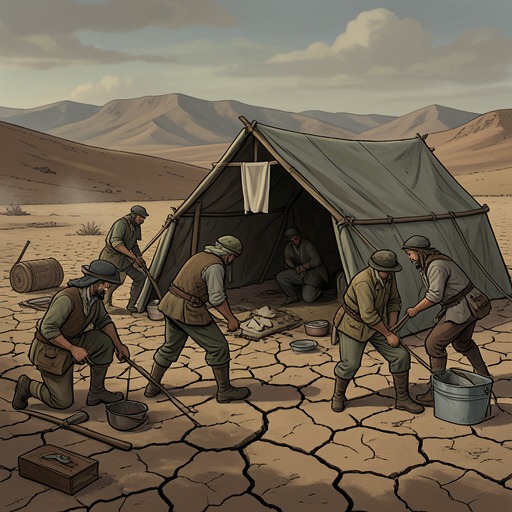
At Red Springs in Southrising, Shevek was posted to an emergency farm draft late in the summer. After seasonal rain in the equatorial storm region, workers were trying to plant and reap a crop of grain holum before the drought returned. Shevek had expected an emergency assignment because his construction work had ended and he had made himself available in the general labor pool. His posting therefore illustrates the labor rules as organized reassignment: ordinary work could give way to tasks judged necessary for immediate survival.
The emergency did not extinguish voluntary action. When wells in Abbenay’s northern suburbs failed, volunteers—skilled and unskilled workers, adults and adolescents—laid temporary water mains from other districts in their free time. They finished the job in thirty hours. That rapid collective response stands beside the compulsory or urgent labor drafts: the crisis depended both on organized allocation and on people choosing to contribute beyond their assigned work. Mutual trust helped counter fear, and residents expressed confidence that they would get through the emergency together.
The drought also strained the transport network that moved food between regions. After a year of crisis, the ordinary lines could not meet the demand, despite transport workers’ efforts. Vehicles and personnel were scarce; trucks, trains, ships, ports, and yards were pressed into service with the help of apprentices, retired workers, volunteers, and emergency draftees. Provision trains took precedence over other traffic. Shevek’s train consequently travelled in fits and starts before stopping for twenty hours after a dispatching error and a wreck farther up the line.
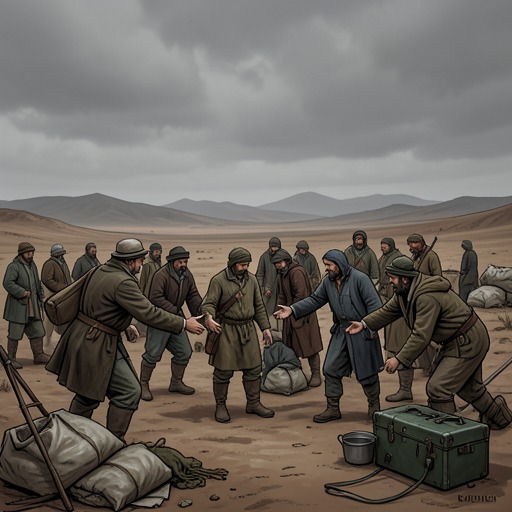
At the mill town where the train halted, the rules of sharing confronted a severe local shortage. The town had no surplus in its commons or warehouses and relied on transport for food. Its 160 residents faced 450 stranded passengers who had already missed breakfast. Giving the passengers food might leave the town without supplies for days, with no certainty that another provisions train would arrive soon. The townspeople gave them nothing; the travelers eventually fasted for sixty hours before reaching a station with a passenger refectory. The episode makes the conflict concrete: a general commitment to share could not settle how to divide a supply too small for all, especially when each community feared being left without food in turn.
Scarcity and the Limits of Allocation
For Shevek, the stoppage was his first experience of hunger. He had sometimes skipped meals by choice while working, but food had always been available; he had not imagined being unable to eat. As the train remained on the siding, he considered whether his society could pass through famine without losing the solidarity on which it depended. Sharing was easier when there was at least barely enough to go around. When there was not, he saw the danger that force, power, violence, and deliberate refusal to notice others could enter the allocation of necessities.
The passengers’ discussion sharpened that concern. Some seriously proposed raiding the town’s truck gardens, while anger at the townspeople grew. Yet the confrontation did not end in a raid: the train finally sounded its departure, and the passengers continued on. At the next station, they received a half loaf of holum bread and a bowl of soup. Their relief and laughter showed that the passengers had endured the delay together, but the episode did not erase the moral problem of the town’s refusal. The scarcity had produced neither an easy proof of social failure nor a painless example of solidarity; it exposed the conditions under which sharing became difficult to sustain.
A different allocation dilemma appears in a conversation about ration lists at the mills in Elbow. A former worklister recalled that, when rations were cut, workers doing six hours in the plant received full rations—barely enough for that work—while people on half time received three-quarter rations. Those deemed sick or too weak to work were assigned half rations, a level at which they might survive but could not recover enough to return to work. The worklister had been required to put already sick people on those lists. Although he himself worked long hours and received full rations, he understood that his administrative task amounted to deciding who would starve. He quit and went to Grand Valley, but another person took over the list-making. His departure ended his own participation, not the system that required someone to make the decisions.
The driver who discussed the lists rejected that task as incompatible with Odonian responsibility. In his view, the mills should have been shut down rather than making an individual choose which people received the means to recover and work. He distinguished this burden from sudden acts committed in hunger or anger, such as attacks on trains: those involved immediate reactions, whereas a worklister was asked to make an enduring administrative judgment about whose survival counted. The dispute exposes a central danger in emergency allocation. Rules may distribute limited supplies according to work capacity, but when illness itself lowers a person’s ration, the policy can trap the sick outside the conditions needed to become well again.
Political Exceptions and the Meaning of the Rules
The drought measures belong to a wider pattern in which proclaimed emergencies change what ordinary rules permit. On Urras, war over Benbili brings restrictions on research publication and travel. Research at the College of Noble Science may be classified, papers may be delayed, and foreign scholars are not supposed to leave campus without clearance, even though officials can sometimes help them evade the restrictions. This is not an Anarresti drought policy, but its contrast clarifies the different pressures the novel places on emergency rules: a crisis can be invoked to centralize control, while on Anarres the drought makes allocation and labor urgent without removing the underlying conflict between collective need and individual judgment.
Anarres’s own isolation also has a formal boundary. Under the Terms of the Closure of the Settlement, people arriving from Urras may not leave their freight ships beyond the boundary of the Port of Anarres. The rule concerns access rather than drought rationing, but it underscores that collective arrangements operate within limits on movement as well as limits on resources. Likewise, Anarres’s dependence on trade with Urras complicates any image of self-sufficiency: the freighters bring petroleum products, machine parts, and other supplies while taking away minerals, and protests against the bargain continue because people fear that ending it could invite invasion.
The emergency rules therefore expose a tension rather than resolving it. Strict rationing, reduced hours, labor drafts, and transport priorities are responses to a real ecological crisis, not proof that social commitment has disappeared. Volunteers can restore a failed water connection in thirty hours, and passengers can leave a meagre meal laughing after enduring hunger together. Yet ration lists, the closed commons at a mill town, and the pressure to decide who is too weak to work show how scarcity can convert coordination into exclusion. The crisis tests whether solidarity remains a lived practice when there is not enough to share, and whether procedures designed to distribute survival can avoid making some people bear the cost of everyone else’s emergency.